
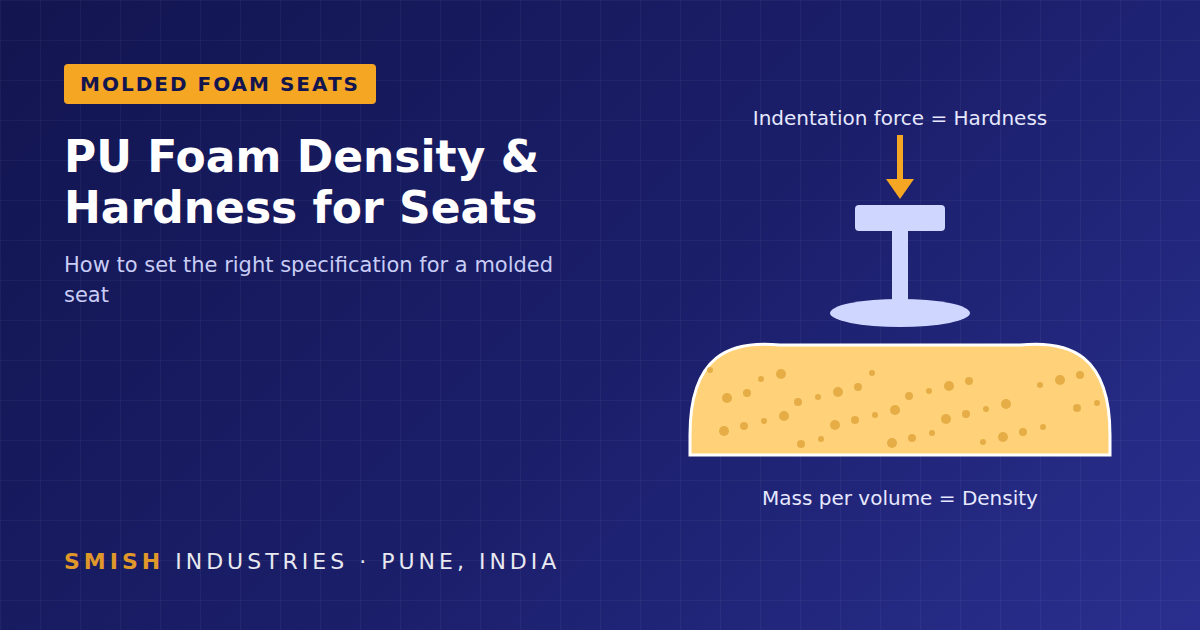
'What density should we use for the seat?' is one of the most common questions in a molded foam enquiry. It is also one of the most commonly oversimplified. Density matters, but it does not decide comfort alone, and a number copied from another project can easily be wrong for your seat. This guide explains how PU foam density for a seat relates to hardness, comfort, support and durability, so your team can set specifications with confidence.
Quick Answer
Foam density is the mass per unit volume of the foam. It mainly influences durability, weight and cost. Hardness is how firm the foam feels under load, and it mainly influences comfort and support. They are related but separate properties. The right combination for a molded foam seat depends on the application, seat geometry, occupant load, base structure, usage cycle and the OEM's test requirements. It should be confirmed through samples and testing.
What Is Foam Density?
Density is the weight of foam in a given volume, commonly expressed in kg/m³. In molded seats, density can vary between the outer skin and the core and across different areas of the part. So it is important to agree how and where density is measured, for example as overall part density or core density from a specified sample location.
Density generally affects:
- Durability: higher-density foams tend to resist loss of thickness and firmness better over time, all else being equal.
- Weight: relevant for vehicles and portable products.
- Material cost: more material per part usually means higher cost.
What Is Foam Hardness?
Hardness describes the force needed to compress the foam by a set amount. It is measured with standard indentation methods, often called IFD, ILD or indentation hardness, depending on the standard used. Hardness is what a user feels as soft or firm.
Hardness mainly affects:
- Initial comfort: how the seat feels when first sat on
- Support: whether the occupant sinks too far or bottoms out
- Posture: how well the seat holds the body position over time
How Are Density and Hardness Related?
A common misunderstanding is that 'high density' means 'hard'. In practice, formulation and processing let manufacturers produce foams of similar density with different hardness, and similar hardness at different densities, within limits. That is why a specification should state both properties and the test methods, not density alone.
- Same density, different hardness: possible through formulation changes. Two seats can weigh the same but feel very different.
- Same hardness, different density: possible within limits. The lower-density option may feel similar at first but may not hold up the same way in long-term use.
Comfort vs Support: Why Both Matter
Comfort and support pull in different directions:
- Foam that is too soft feels comfortable at first but may let the occupant sink through to the base, reducing support and causing fatigue.
- Foam that is too firm gives support but creates pressure points and discomfort over long periods.
Good seat design balances both. It often uses geometry and zoned firmness, for example firmer side bolsters for lateral support and a more compliant central zone for comfort.
Durability: What Makes a Seat Keep Its Shape?
Over time, repeated loading can reduce foam thickness and hardness. How much depends on:
- Foam density and formulation
- Load level and how often the seat is used (single shift vs multiple shifts)
- Operating temperature and humidity
- Vibration exposure, especially in off-highway and commercial vehicles
- Foam thickness in the loaded zones
- Support structure beneath the foam
Durability is usually verified with tests such as compression set and dynamic or static fatigue. The methods and pass criteria are defined by the OEM's specification.
How Does the Application Change the Specification?
- Passenger vehicles: comfort, NVH behaviour, weight and long-term durability are all important, and OEMs typically have detailed specifications.
- Commercial vehicles and buses: long operating hours and frequent use increase the emphasis on durability.
- Tractors, construction and earth-moving equipment: vibration, shock, heat, dust and long shifts require strong support and durability.
- Forklifts and industrial seating: frequent on-off use and multi-shift operation.
- Office and public furniture: comfort for long sitting periods, with durability expectations set by the furniture brand.
- Two-wheelers: limited foam thickness means hardness and contour must work closely together.
Because the conditions differ so much, we do not recommend adopting a density or hardness value from another application without validation.
How Does Seat Design Affect Foam Selection?
- Foam thickness: thinner sections need firmer or denser foam to avoid bottoming out. Thicker sections allow softer foam.
- Base structure: a solid pan, springs or suspension each change how the foam is loaded.
- Contour: well-shaped contours distribute load, which can allow softer foam without losing support.
- Cover material: stiffer covers change the perceived feel.
- Inserts and frames: foamed-in parts change local stiffness.
A Practical Process for Setting Specifications
- Define the use case: application, occupant load range, hours of use, environment and vibration.
- Review geometry: seat CAD, foam thickness in load zones and base structure.
- Set target ranges: density and hardness ranges, with test methods and measurement locations.
- Define durability tests: compression set, fatigue and any flammability or other industry requirements.
- Sample and evaluate: produce samples, test them, and run sitting trials with real users.
- Refine and freeze: adjust formulation or design, then freeze the specification for production.
- Control in production: agree which properties are checked per batch and how.
Common Mistakes to Avoid
- Specifying density only: without hardness and test methods, two suppliers can deliver very different seats.
- Copying values from another seat: different geometry and use lead to different results.
- Ignoring measurement methods: results vary with test standard, sample size and location. Agree them in writing.
- Judging comfort in a few seconds: short sitting trials favour softer foam. Evaluate over realistic durations.
- Skipping durability tests: initial feel says little about how the seat will perform after long use.
For a broader overview of foam density and indentation hardness across applications, see our PU foam density and ILD guide.
Frequently Asked Questions
What is the best PU foam density for a seat?
There is no universally correct density. It depends on the application, seat design, load, usage and test requirements. The right value is set by the OEM specification and confirmed through sampling and testing.
Does higher density mean a harder seat?
Not necessarily. Density and hardness are separate properties. Formulation can produce different hardness at similar densities.
Why does a new seat feel different after a few months?
Repeated loading can reduce foam thickness and hardness over time. Density, formulation, load and environment affect how much. Durability testing helps predict and limit this change.
Can one seat have different hardness in different areas?
Yes. Zoned or dual-hardness seats are used to give firmer support in bolsters and more comfort in the centre, depending on design and process capability.
What should I include in a foam seat specification?
Density and hardness targets with tolerances, test methods and measurement locations, durability and other required tests, dimensional requirements and appearance criteria.
Related from SMISH Industries
- Molded foam manufacturer in Pune
- Foam Fitment – product page
- PU foam density and ILD guide
- Polyurethane foam for automotive manufacturing
Need Help Defining Your Seat Foam Specification?
Share your seat drawing or CAD data, application, target feel and test requirements with SMISH Industries. We can discuss density and hardness targets, develop samples for evaluation and quote for production.
Phone: 08048036495 | Email: smishassociate@gmail.com
Factory: Gat No. 1408, Mahalaxmi Industrial Estate, Chikhali, Pune, Maharashtra 411062
Keywords