
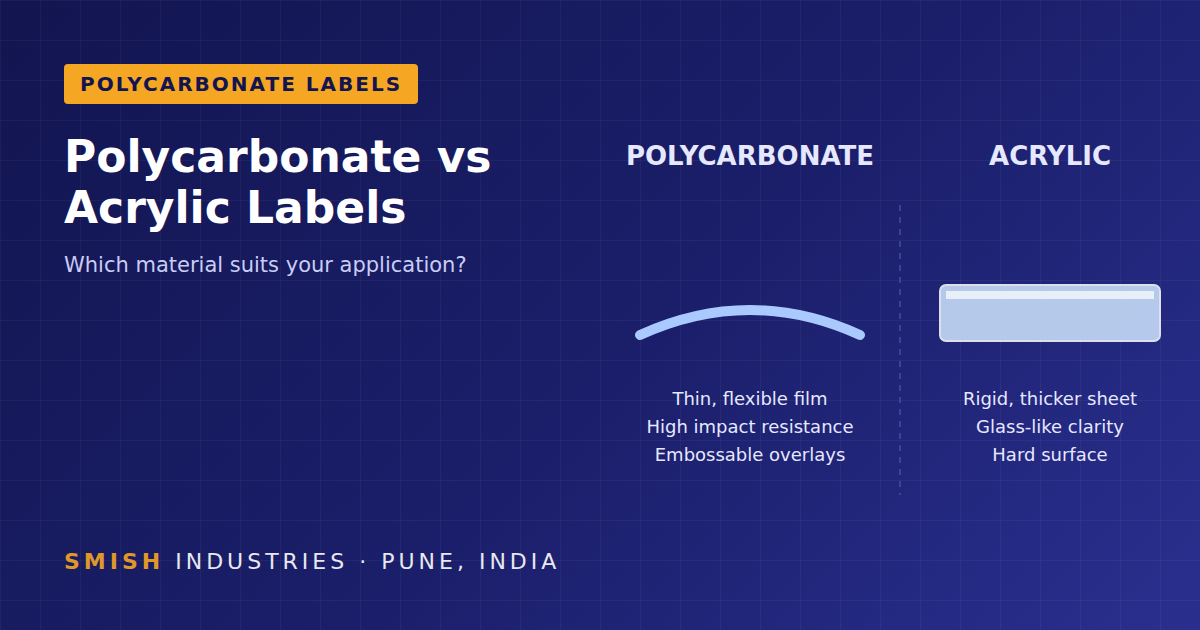
Polycarbonate and acrylic look similar on a sample board: both are clear plastics that can be reverse printed for a glossy, premium panel. In service they behave quite differently. This guide compares polycarbonate vs acrylic labels for industrial and OEM use, so you can match the material to the job instead of choosing by appearance alone.
Quick Answer
Polycarbonate (PC) is tougher and more flexible. It suits thin labels, graphic overlays, keypads and parts exposed to impact or flexing, and it can be embossed. Acrylic (PMMA) is more rigid and offers excellent clarity and good surface hardness. It suits thicker nameplates, display windows and decorative panels where stiffness and a glass-like finish matter. Neither is universally better. The right choice depends on the application.
What Are Polycarbonate Labels?
Polycarbonate labels are made from thin, clear PC film, usually reverse-printed and die-cut, with adhesive on the back. They are widely used for control panels, membrane keypad overlays, equipment fascias and industrial nameplates. Learn more on our polycarbonate label page.
What Are Acrylic Labels?
Acrylic labels are made from polymethyl methacrylate (PMMA), usually in a thicker, rigid sheet form. They are often reverse printed, cut to shape and fixed with adhesive tape. They are used where a solid, glass-like nameplate or window is wanted. See our acrylic labels page.
Polycarbonate vs Acrylic: Material Comparison
- Typical form for labels – PC: thin, flexible film. Acrylic: thicker, rigid sheet.
- Impact resistance – PC: very high, resists cracking. Acrylic: lower, can crack or chip under impact.
- Flexibility – PC: flexible in thin gauges and follows gentle curves. Acrylic: rigid, best on flat surfaces.
- Surface hardness – PC: uncoated PC scratches more easily, and hard-coated grades improve this. Acrylic: generally harder surface with good scratch resistance.
- Optical clarity – PC: good. Acrylic: excellent, glass-like.
- Embossing – PC: embosses well for tactile keys and raised features. Acrylic: not suitable for thin-film embossing.
- Printing – Both: commonly reverse printed. PC is the usual choice for overlays with windows and dead-front effects.
- Cutting – PC: die cutting for thin films. Acrylic: often laser or CNC cut, with a polished edge possible.
- Chemical resistance – Both: sensitive to certain solvents. Resistance depends on the chemical, so test against the real exposure.
- Typical applications – PC: overlays, keypads, control panels, flexible nameplates. Acrylic: rigid nameplates, display windows, decorative panels, signage-style labels.
Impact Resistance: Which Handles Knocks Better?
Polycarbonate is known for toughness. It flexes and absorbs impact where acrylic may crack. For equipment that gets knocked, vibrated or handled roughly, such as construction machinery panels, agricultural equipment or portable devices, PC is usually the safer choice. Acrylic can work well in protected positions, for example on a front panel that is not exposed to impact.
Flexibility: Flat vs Curved Surfaces
Thin PC film can be applied to gently curved panels and can flex during installation without cracking. Acrylic labels are rigid and should generally be applied to flat surfaces. If your panel has any curvature or is likely to flex, PC is the more forgiving material.
Surface Finish and Appearance
Acrylic is valued for its deep, glass-like clarity. A thick reverse-printed acrylic nameplate gives a strong sense of depth. Polycarbonate offers more finish variety in label form, including gloss, matte, velvet and textured surfaces, plus selective finishes such as a gloss window in a matte panel. For fingerprint and glare reduction on control panels, textured PC is common. For a showpiece nameplate, acrylic may be preferred.
Printing Considerations
- Both materials are commonly reverse printed so the ink is protected behind the clear layer.
- PC is the usual material for graphic overlays with transparent windows, LED indicators and dead-front icons.
- With thick acrylic, the viewing depth changes how the graphics look. Colours and fine details should be approved on a physical sample.
Adhesion Considerations
Both labels rely on pressure-sensitive adhesives chosen for the substrate. Thin, flexible PC labels conform to the surface and make full contact easily. Rigid acrylic labels need a flat mounting surface, or a thicker adhesive or foam tape to make up for minor unevenness. In both cases, surface cleaning before application is critical.
Durability in Industrial Environments
- UV: both are available in grades suitable for outdoor use. Confirm UV performance of the film or sheet and the inks.
- Scratch and abrasion: acrylic's harder surface is an advantage. PC can match or exceed it with hard-coated films or textured finishes.
- Impact and vibration: PC is generally more robust.
- Chemicals: both can be affected by certain solvents and cleaners. Declare exposures and test samples.
- Temperature: check the adhesive rating and the material's behaviour at your operating temperatures.
Cost Considerations
Neither material is always cheaper. Cost depends on:
- Thickness (thin PC film vs thicker acrylic sheet)
- Surface finish or hard coating
- Printing complexity and number of colours
- Cutting method and edge finish
- Embossing, windows and other features
- Order quantity
The best comparison is a quotation for both options on your actual design.
Which Material Should You Choose?
Consider polycarbonate when:
- The label is a graphic overlay, keypad or control panel interface
- You need embossed keys or tactile features
- The part may face impact, vibration or flexing
- The surface is gently curved
- You need windows, dead-front icons or selective finishes
Consider acrylic when:
- You want a rigid, thick nameplate with a glass-like depth
- The mounting surface is flat and protected from impact
- Surface hardness and optical clarity are priorities
- Polished edges or a solid, premium feel are required
Frequently Asked Questions
Is polycarbonate stronger than acrylic?
Polycarbonate has much higher impact resistance and is less likely to crack. Acrylic has a harder surface and better scratch resistance when uncoated. 'Stronger' depends on which property matters for your application.
Which scratches less, acrylic or polycarbonate?
Uncoated acrylic generally resists scratching better than uncoated PC. Hard-coated or textured PC films narrow or close that gap.
Can acrylic labels be used on curved surfaces?
Acrylic is rigid and is generally best on flat surfaces. For curved panels, thin polycarbonate film is usually more suitable.
Which is better for membrane keypads?
Polycarbonate is commonly used as the top overlay on membrane keypads because it prints well, embosses cleanly and flexes with key presses.
Can you supply both materials for comparison?
Yes. For many projects we can quote both options and prepare samples, so your team can compare appearance and fit on the actual product.
Related from SMISH Industries
- Polycarbonate Label – product page
- Acrylic labels
- Polycarbonate vs polyester labels
- Industrial labels
- All SMISH products
Compare Both Options for Your Product
Not sure whether polycarbonate or acrylic suits your panel or nameplate? Send SMISH Industries your drawing, artwork, mounting surface and operating conditions. We can recommend a material and quote both options where that helps your decision.
Phone: 08048036495 | Email: smishassociate@gmail.com
Factory: Gat No. 1408, Mahalaxmi Industrial Estate, Chikhali, Pune, Maharashtra 411062
Keywords