
Polycarbonate labels sit on some of the hardest-working surfaces in industry: control panels, machine fascias, instrument clusters, keypads and equipment housings. For OEMs sourcing from a polycarbonate labels manufacturer in India, it pays to understand what the material does well, how it is printed and finished, and which details must be specified to get consistent results.
Quick Answer
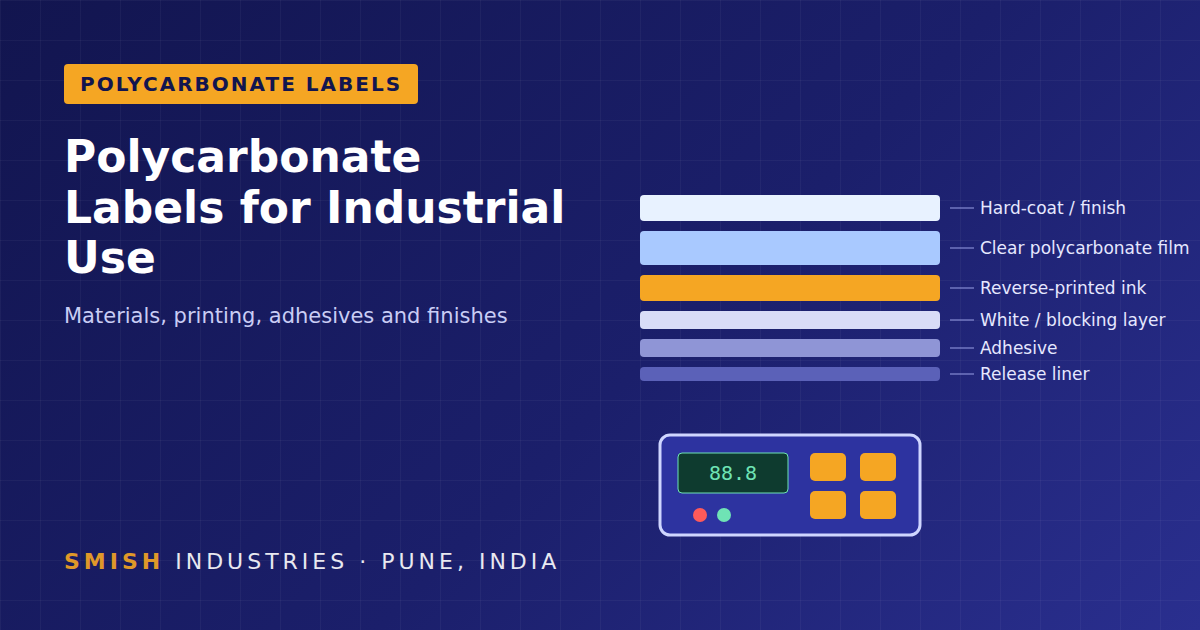
Polycarbonate (PC) labels are made from a tough, transparent thermoplastic film, usually reverse-printed so the graphics sit behind the film and are protected from wear. PC is used for industrial labels, graphic overlays and membrane keypad fascias because it combines impact resistance, dimensional stability and good printability. It can be embossed, window-cut and given gloss, matte or textured finishes.
What Is Polycarbonate?
Polycarbonate is an engineering thermoplastic known for high impact strength and good optical clarity. For labels it is supplied as a thin film in a range of gauges and surface finishes. Thin PC film is flexible enough to die-cut and apply to flat or gently curved panels. It is also stiff enough to give a crisp, panel-like appearance.
Why Is Polycarbonate Used for Industrial Labels?
- Toughness: PC resists cracking from impact and handling better than many rigid plastics.
- Subsurface printing: the clear film allows reverse printing, so the ink layer is protected behind the film.
- Dimensional stability: good for labels that must align accurately with switches, LEDs, displays and cut-outs.
- Formability: PC can be embossed to create raised keys, borders or logos with a tactile feel.
- Finish options: gloss, matte, velvet and textured surfaces, plus clear or tinted display windows.
PC has limits too. Uncoated PC can scratch, and some solvents and aggressive chemicals can attack it. Where chemical or abrasion exposure is significant, hard-coated PC films or an alternative material such as polyester may be considered. See our polycarbonate vs polyester comparison.
What Printing Options Are Used for Polycarbonate Labels?
Reverse (second-surface) printing
Artwork is printed in reverse on the back of the clear film and viewed through it. The film protects the ink from abrasion, cleaning and handling. Most industrial PC labels and overlays are made this way.
Screen printing
Screen printing lays down opaque, consistent ink films and is well suited to solid colours, backgrounds, dead-front effects and transparent colour windows for LEDs. It is widely used for graphic overlays and control panels.
Digital printing
Digital printing suits complex multi-colour artwork, gradients and short runs or variants. It is often combined with screen-printed layers such as white backers or opaque blocking layers.
Special effects
- Dead-front printing: icons or indicators are invisible until backlit.
- Transparent or tinted windows: for displays and LED indicators.
- Selective texture or gloss: for example a matte panel with a gloss display window.
What Adhesive Options Are Available?
The adhesive is chosen for the substrate, the environment and the product's service life:
- Permanent acrylic adhesives for metal, painted surfaces and most engineering plastics.
- High-tack adhesives for low-surface-energy plastics and some powder-coated finishes.
- Thicker adhesive or foam constructions for textured surfaces or to bridge minor unevenness.
- Selective adhesive patterns with adhesive-free zones for display windows, switch areas or vent paths.
Adhesive performance should be confirmed on the actual panel material with its real surface finish.
Which Surface Finishes Can Be Specified?
- Gloss: bright, high-clarity appearance. Suits display windows and decorative panels.
- Matte / velvet: reduces glare and hides fingerprints and light scratches. Common on control panels.
- Textured: tactile surface that hides wear on frequently touched areas.
- Hard-coated: a surface coating that improves scratch and chemical resistance, useful for demanding environments.
How Are Polycarbonate Labels Die Cut?
After printing, PC labels are cut to shape, including outer profiles, internal windows, switch holes and mounting cut-outs. Accurate registration between print and cut is critical. A few tenths of a millimetre of misalignment can show up clearly against a switch or display. Tool type and cutting method are chosen based on part geometry, tolerances and quantity. For tight-tolerance work, the drawing should specify critical dimensions and the reference edges or holes for measurement.
What Are Polycarbonate Graphic Overlays?
A graphic overlay is the printed top layer of a control panel or keypad, the part the user sees and touches. PC is a common overlay material because it prints well from behind, embosses cleanly and holds registration with switches and windows. Overlays may be applied on a flat panel, used as the top layer of a membrane keypad, or combined with windows, embossed keys and backlighting features.
How Durable Are Polycarbonate Labels?
Service life depends on the environment and specification:
- Abrasion: reverse printing protects graphics. Hard-coated or textured films help resist surface scratching.
- UV: outdoor use requires UV-resistant film grades and suitable inks.
- Chemicals: declare cleaners, oils and solvents, since some attack PC. A hard coat or a different material may be required.
- Temperature: the adhesive and film must be rated for your operating and peak temperatures.
We recommend validating samples with your own environmental and cleaning tests before production approval.
Where Are Industrial Polycarbonate Labels Used?
- Machine control panels and operator interfaces
- Membrane keypads and switch fascias
- Generator and power equipment control panels
- Agricultural and construction equipment dashboards
- Electronics and appliance front panels
- Medical and laboratory equipment interfaces
- Nameplates, rating labels and branding panels
How Can OEMs Customise Polycarbonate Labels?
- Film gauge and surface finish
- Colour matching to brand or panel colours
- Display windows (clear, tinted or with selective finish)
- Embossed keys, rims or logos
- Dead-front and backlighting effects
- Adhesive type and adhesive-free zones
- Supply format suited to your assembly process
What Quality Checks Matter?
- Colour match against the approved master sample
- Print-to-cut registration and critical dimensions
- Window clarity, free of specks, scratches or ink contamination
- Consistency of emboss height and position (where applicable)
- Adhesive coverage and liner release
- Protective film on the face, where required, to prevent scratches during handling
Frequently Asked Questions
Why are polycarbonate labels reverse printed?
Printing on the back of clear film places the ink behind the film, so it is protected from abrasion, cleaning and handling. The graphics stay intact even when the surface is used heavily.
Is polycarbonate suitable for outdoor labels?
Yes, when UV-resistant film grades and suitable inks and adhesives are specified. Always tell your supplier about outdoor exposure.
What is the difference between a polycarbonate label and a graphic overlay?
A graphic overlay is a type of PC label designed as the user-facing layer of a control panel or keypad, usually with windows, key areas and precise registration. A PC label can also be a simpler nameplate or information label.
Can polycarbonate labels be embossed?
Yes. PC can be embossed to create raised keys, borders or logos. Emboss design must account for the film gauge and the artwork position.
What information is needed for a quotation?
A drawing with dimensions and cut-outs, artwork, film finish, adhesive and substrate details, environmental conditions and estimated quantity.
Related from SMISH Industries
- Polycarbonate Label – product page
- Polycarbonate label supply with pan-India delivery
- Graphics labels
- Industrial labels
- Choosing a polycarbonate label manufacturer
Request a Polycarbonate Label Quotation
Developing a control panel, overlay or industrial label for your OEM product? Send SMISH Industries your drawing, artwork, finish requirements, substrate details and estimated quantity. We will review the design and share a quotation along with sampling options.
Phone: 08048036495 | Email: smishassociate@gmail.com
Factory: Gat No. 1408, Mahalaxmi Industrial Estate, Chikhali, Pune, Maharashtra 411062
Keywords