
When a product needs a foam seat, cushion or pad, the first decision is often made without being discussed: will it be molded, or cut from foam blocks? Each route has a different cost structure, shape capability and quality profile. This comparison of molded foam vs cut foam is meant to help OEMs and product designers choose the right process for their part and production volume.
Quick Answer
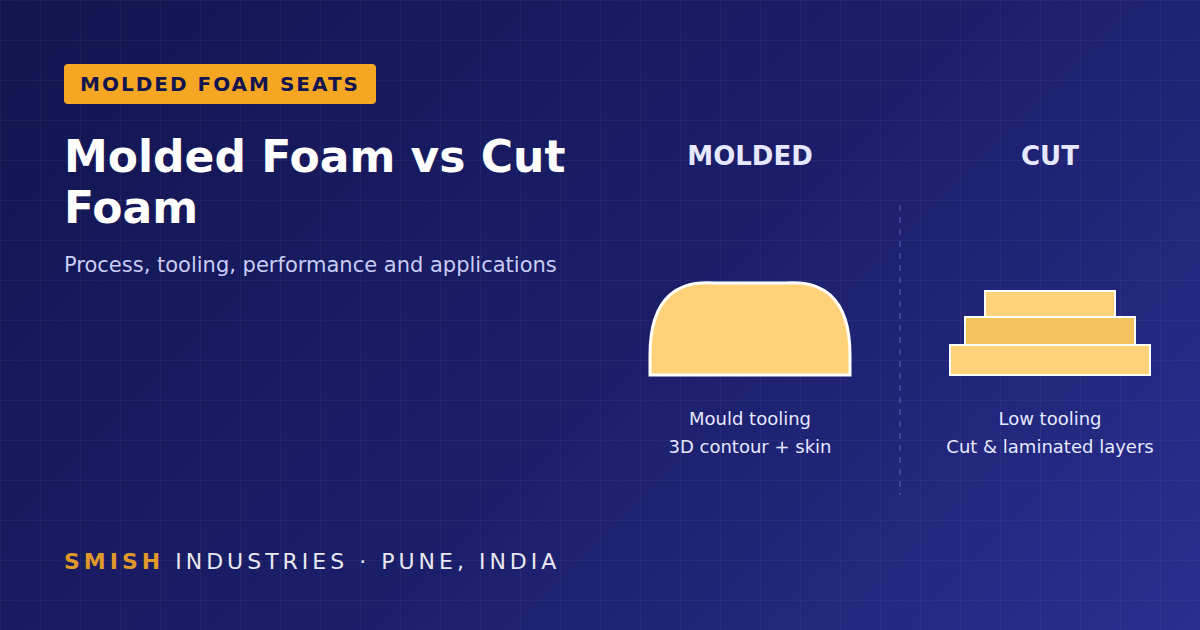
Molded PU foam is formed directly in a shaped mould, producing a finished 3D part with a surface skin and high shape repeatability. It needs mould investment. Cut foam is fabricated from slabstock blocks by cutting, contouring and gluing. It needs little or no tooling but is limited in shape complexity and finish. Molded foam is generally considered for complex contoured parts at steady volumes. Cut foam suits simpler shapes, prototypes and low volumes.
How Is Molded Foam Made?
Liquid polyol and isocyanate are mixed and dispensed into a temperature-controlled mould. The mixture expands, fills the cavity and cures into the final shape, forming a skin against the mould surface. After demoulding, the part is crushed if needed to open the cells, then trimmed and inspected. Inserts such as frames or fasteners can be foamed in place if the mould is designed for them. Read more in our PU foam molding guide.
How Is Cut Foam Made?
Cut foam starts as slabstock, which is large blocks of foam produced continuously and cured. The blocks are sliced into sheets and then shaped by:
- Band-saw or horizontal/vertical cutting for basic shapes
- CNC contour cutting for profiles
- Die cutting for flat parts at volume
- Lamination and gluing of layers to build thickness or combine different foams
Cut foam is also used widely for gaskets, packaging inserts and fitments. See our foam die cut and foam fitment ranges.
Molded Foam vs Cut Foam: Comparison
- Manufacturing process – Molded: chemical foaming inside a shaped mould. Cut: mechanical cutting and gluing of foam blocks.
- Tooling – Molded: dedicated mould required. Cut: low tooling, such as cutting programmes, templates or dies.
- Shape complexity – Molded: true 3D contours, undercuts (within mould limits), channels and varying thickness. Cut: mainly 2D and 2.5D profiles, with complex shapes built by gluing layers.
- Surface finish – Molded: continuous skin from the mould surface. Cut: open-cell cut surface with no skin.
- Dimensional repeatability – Molded: high, because each part comes from the same tool. Cut: depends on cutting method and operator steps, and glued assemblies add variation.
- Inserts – Molded: can be foamed in place. Cut: must be added after cutting.
- Property control – Molded: density and hardness engineered into the part, and zoning is possible. Cut: limited to the grades of slabstock available, though layers can combine grades.
- Production volume – Molded: best at medium to high, steady volumes. Cut: well suited to prototypes, low volumes and frequent design changes.
- Lead time to first parts – Molded: longer, because the mould must be built. Cut: shorter.
- Material utilisation – Molded: close to net shape, with trimming waste. Cut: generates offcuts from blocks.
Tooling: The Main Trade-Off
The mould is the biggest difference in cost structure. Molded foam needs upfront investment in a mould whose cost depends on part size, complexity, number of cavities and mould material. Once the mould is in place, part cost and consistency benefit at steady volumes. Cut foam avoids that investment. That makes it attractive for prototypes, pilot builds and products with low or uncertain volumes. Per-part labour, however, can be higher when complex shapes need several cutting and gluing operations.
Shape Complexity
If the part has flowing 3D contours, such as a contoured seat, headrest or ergonomic cushion, molding reproduces the shape directly. Achieving a similar shape with cut foam usually means stacking and gluing layers, then contour-cutting. That can leave steps, glue lines and variation. For flat or simply profiled parts such as rectangular pads, gaskets and packaging inserts, cut foam is often the most practical method.
Dimensional Repeatability
Molded parts from a well-maintained mould and a controlled process are highly consistent in shape. That helps with cover fit, frame assembly and appearance across a production run. Cut foam can also be accurate, especially with CNC or die cutting, but multi-step fabrication and glued joints add variation.
Surface Finish
The skin on molded foam gives a smoother, more closed surface. It helps covers slide on and fit cleanly and can reduce abrasion between foam and cover. Cut foam shows an open-cell surface. That works well under covers in many applications but may need a scrim, fabric or film layer for some uses.
Performance
Molded foam lets density, hardness and even zoned firmness be engineered into a single part. It also allows inserts to be foamed in. Cut foam relies on the properties of the slabstock grade selected. Combining grades is possible by layering, but glue lines can create stiff areas. Durability of both depends mainly on the foam formulation, density and application, not simply on the process.
Cost Considerations
Total cost depends on:
- Tooling investment (mould vs cutting tools)
- Annual volume and batch sizes
- Part complexity and number of fabrication steps
- Material usage and scrap
- Required properties and testing
- Design stability, since frequent changes favour low-tooling methods
For a meaningful comparison, quote both routes on the same drawing and volume, and include tooling amortisation in the comparison.
When Can Molded Foam Be Considered Instead of Cut Foam?
- The part has complex 3D contours that are difficult to cut or need many glued layers.
- Volumes are steady enough to justify a mould.
- The design is frozen, or changes are expected to be minor.
- Shape consistency is important for cover fit or assembly.
- You need foamed-in inserts or zoned firmness.
- A finished skin surface adds value.
When Is Cut Foam the Better Choice?
- Prototypes, pilot builds and design validation
- Low or uncertain volumes
- Flat or simply profiled parts
- Frequent design changes
- Packaging inserts, gaskets and pads where a skin is not required
A common path is to prototype with cut foam, validate the design, then move to molded foam once the design and volumes are confirmed.
Where Is Each Process Typically Used?
- Molded foam: automotive and commercial vehicle seats, off-highway operator seats, headrests, armrests, office chair seats and backs, and ergonomic cushions.
- Cut foam: furniture cushions with simple shapes, mattress layers, packaging inserts, gaskets, acoustic pads and prototype seats.
Frequently Asked Questions
Is molded foam better than cut foam?
Neither is better in every case. Molded foam suits complex, repeatable parts at steady volumes. Cut foam suits simpler shapes, prototypes and low volumes.
Why is molded foam tooling expensive?
The mould must reproduce the part geometry precisely, handle heat and pressure, include venting and insert locations, and last through production. Cost depends on size, complexity and cavities.
Can I start with cut foam and move to molded later?
Yes. Many OEMs validate a design with cut foam prototypes, then invest in a mould once the design and volumes are stable.
Does molded foam last longer than cut foam?
Durability depends mainly on foam formulation, density and application conditions. Molded foam's shape consistency and skin can help cover fit and wear, but the process alone does not decide lifespan.
Do you offer both molded and cut foam components?
SMISH Industries manufactures molded foam components as well as foam die cuts and foam fitments, so we can suggest the route that suits your design and volume.
Related from SMISH Industries
- Molded foam manufacturer in Pune
- Foam Fitment – product page
- Foam die cuts and fitments
- Foam die cut manufacturers in India
- PU foam for automotive components
Molded or Cut? Let's Review Your Part
Send SMISH Industries your drawing or CAD data, required properties and expected annual volume. We will review which manufacturing route suits your part and quote accordingly, including tooling where required.
Phone: 08048036495 | Email: smishassociate@gmail.com
Factory: Gat No. 1408, Mahalaxmi Industrial Estate, Chikhali, Pune, Maharashtra 411062
Keywords