
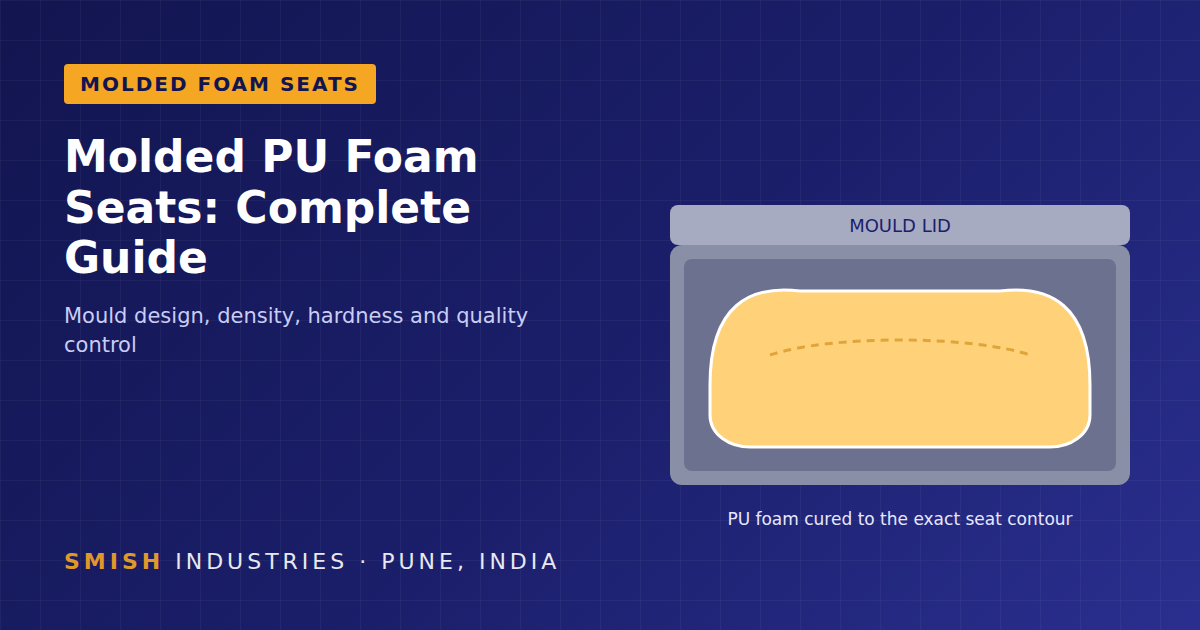
Seats on tractors, construction machines, forklifts, commercial vehicles, two-wheelers and office furniture share a hidden core: a molded polyurethane foam pad. That pad decides comfort, support and fit, and much of how long the seat lasts. This guide is for OEM engineers and sourcing teams evaluating a molded foam seat manufacturer in India. It explains how PU molded foam seats are made, which properties matter and what to specify.
Quick Answer
Molded PU foam seats are made by dispensing a liquid polyurethane mixture of polyol and isocyanate into a closed, shaped mould. There it expands, fills the cavity and cures into a seat cushion or backrest with the exact 3D contour of the tool. Molding gives repeatable shape, a sealed surface skin and controlled density and hardness. That makes it a common choice for automotive, off-highway, industrial and furniture seating.
What Is Molded PU Foam?
Molded polyurethane foam is formed by a chemical reaction between a polyol blend and an isocyanate, with additives that control foaming, cell structure and curing. Unlike slabstock foam, which is poured into large blocks and then cut, molded foam is produced directly in the final shape inside a mould. The foam forms a denser skin against the mould surface and an open-cell core inside, giving a finished part that is ready for upholstery or covering.
How Is a Molded Foam Seat Designed?
Mould design
The mould defines the seat's geometry, including contours, bolsters, thigh support, channels for cover attachment and recesses for frames or inserts. Key mould design considerations include:
- Parting line location, which affects appearance and trimming
- Venting, so air escapes and the foam fills sharp features without voids
- Insert locations for metal frames, wires, plates or fasteners that are foamed in place
- Draft and release, so the part can be removed without tearing
- Temperature control, because mould temperature affects curing and surface quality
Mould development usually starts from the customer's 3D CAD data, drawing or a master sample.
Foam density
Density is the mass of foam per unit volume. It influences durability, weight and cost, and it is closely linked to how well the seat keeps its thickness and feel over time. Density is specified by the OEM or developed during sampling according to the seat's load, usage and test requirements.
Hardness
Hardness (firmness) describes how much force is needed to compress the foam. It is measured with standard indentation tests. Hardness and density are related but are not the same thing, and formulation can adjust them partly independently. Some seats use different hardness in different zones, such as firmer side bolsters and a more comfortable centre, which can be achieved through design and processing.
We explain this in more detail in our guide to selecting PU foam density and hardness for molded seats.
How Does the PU Foam Molding Process Work?
- Mould preparation: the mould is cleaned, brought to the right temperature and coated with release agent. Inserts are placed if required.
- Mixing and dispensing: polyol and isocyanate are metered and mixed at controlled ratios, then poured or injected into the mould.
- Foaming and filling: the lid closes. The mixture expands, fills the cavity and forms the skin against the mould surface.
- Curing: the foam cures in the mould for a set time until it can be removed without deformation.
- Demoulding: the part is removed carefully to avoid tearing.
- Cell opening (crushing): where needed, the foam is compressed to open closed cells and prevent shrinkage.
- Trimming and finishing: flash at the parting line is trimmed and the part is checked.
- Inspection and packing: parts are inspected and packed to prevent deformation in transit.
Surface Finish and Appearance
Molded foam develops a skin where it contacts the mould. That gives a cleaner, more uniform surface than cut foam, which helps covers fit smoothly and reduces wear from friction between the foam and the cover. Surface quality depends on mould condition, release agent, venting and process control. Common visual defects to control include voids, surface pinholes, splits, and knit lines where foam flows meet.
Dimensional Accuracy and Repeatability
Because every part comes from the same tool, molded seats offer good shape repeatability across production. This matters for cover fit, seat frame assembly and consistent appearance. Dimensional tolerances for foam are wider than for rigid parts, since foam is soft and can recover after compression. Tolerances and measuring methods should be agreed and written into the drawing.
Comfort and Support
Seat comfort comes from a combination of:
- Seat contour (shape of cushion and backrest)
- Foam hardness and hardness distribution
- Foam density and resilience
- Foam thickness in the load zones
- Suspension or base structure under the foam
- Cover material and how it is attached
A molded seat lets these factors be engineered into one part, rather than assembled from stacked and glued cut layers.
Where Are Molded Foam Seats Used?
Automotive and commercial vehicles
Seat cushions, backrests, headrests and armrests for passenger vehicles, buses, trucks and three-wheelers, where shape consistency and durability under repeated loading are critical.
Off-highway and agricultural equipment
Operator seats in tractors, construction and earth-moving equipment, which need support during long working hours with vibration and rough terrain.
Industrial seating
Seats for forklifts, material-handling equipment, machine operator stations and workshop seating.
Furniture
Office chairs, auditorium and public seating, where molded foam gives consistent contours and a clean base for upholstery.
Other applications
Two-wheeler seats, medical and healthcare seating, and gym and fitness equipment, subject to each industry's own requirements.
How Can Molded Foam Seats Be Customised for OEMs?
- Seat geometry from customer CAD, drawing or sample
- Density and hardness to customer specification
- Foamed-in inserts, frames or fastening points
- Cover attachment features such as trenches or wire channels
- Colour of foam (if visible) and surface finish
- Packaging suited to the part shape and logistics
Quality Control for Molded Seats
Typical checks for molded PU seats include:
- Visual inspection for voids, splits, surface defects and flash
- Dimensional checks against drawing or fixture
- Weight checks as a quick control of fill and density
- Density and hardness testing to agreed methods
- Other tests the customer specifies, such as compression set, fatigue or flammability
We do not assume one test set fits all. Test methods and acceptance limits should be defined by the OEM's specification, and samples approved before production.
Frequently Asked Questions
What is the difference between molded foam and slabstock foam?
Molded foam is formed directly in a shaped mould, with a skin and a repeatable 3D contour. Slabstock foam is made in large blocks and then cut to shape, with no skin and limited shaping.
Do I need to pay for a mould?
Custom molded seats need a dedicated mould. Tooling cost depends on seat size, complexity, number of cavities and mould material. It is quoted separately after reviewing your design.
Can you foam metal frames or inserts into the seat?
Inserts can be foamed in place when the mould is designed for it. Share insert drawings and positions at the enquiry stage.
What density and hardness should my seat use?
No single value suits all seats. It depends on the application, seat geometry, occupant load, base structure and test requirements. These are defined with the OEM and confirmed through samples.
What information do you need to quote a molded foam seat?
3D CAD data or a drawing (or a sample), density and hardness targets if known, insert details, test requirements, annual volume and delivery location.
Related from SMISH Industries
- Molded foam manufacturer in Pune
- Foam Fitment – product page
- Polyurethane foam for automotive manufacturing
- Foam die cuts
- PU foam molding guide
Discuss Your Molded Seat Requirement
Developing a new seat or looking for a second source for an existing molded foam part? Send SMISH Industries your CAD data or drawing, density and hardness targets (if available), test requirements and estimated annual volume. Our team will review feasibility and tooling and share a quotation.
Phone: 08048036495 | Email: smishassociate@gmail.com
Factory: Gat No. 1408, Mahalaxmi Industrial Estate, Chikhali, Pune, Maharashtra 411062
Keywords