
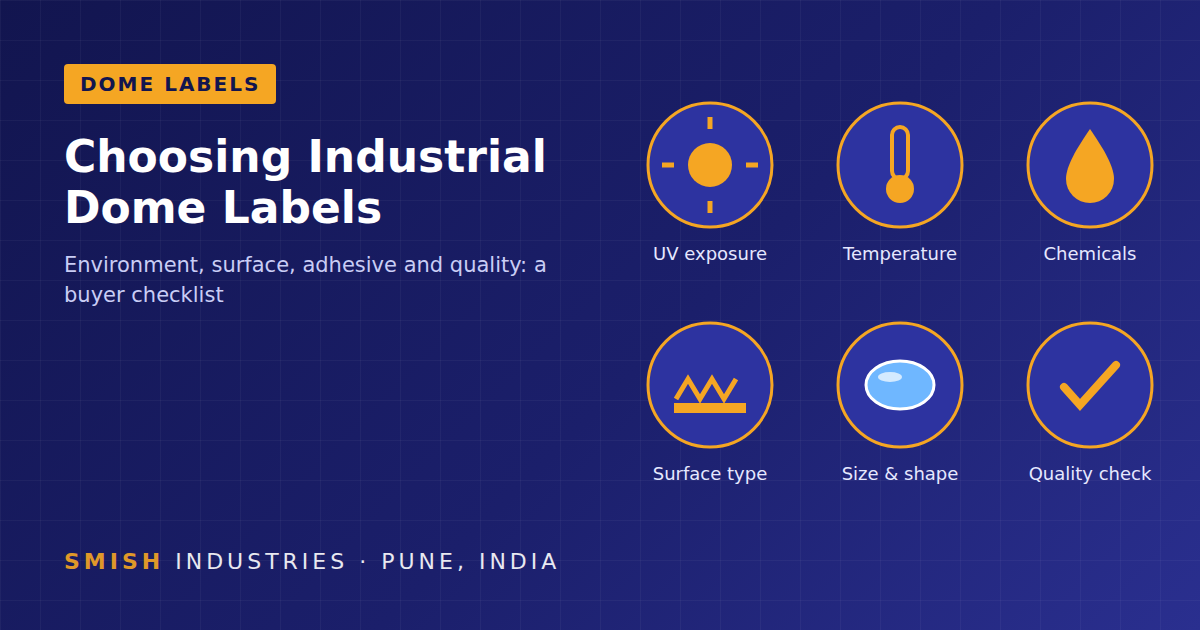
Most dome label problems in the field, such as peeling edges, yellowed domes or labels that lift on textured plastic, come from a specification gap and not from the doming itself. This guide takes purchasing engineers and product designers through the decisions that matter when selecting industrial dome labels and automotive dome labels. It ends with a checklist you can attach to your RFQ.
Quick Answer
To choose the right industrial dome label, start with where it will live: the surface material and texture, the temperature range, UV and weather exposure, chemicals it may contact, and how it will be applied. These factors decide the base film, resin, adhesive, size and dome profile. Logo design comes after that. Always approve samples on your actual part before series production.
Step 1: Define the Operating Environment
Environment is the most important input because it drives every material choice. Before you contact a supplier, answer these questions:
- Will the product be used indoors, outdoors, or both?
- Is the label near a heat source such as an engine, motor, exhaust, lamp or power electronics?
- Will it be washed, pressure-cleaned or wiped with solvents or disinfectants?
- Is there contact with fuel, hydraulic oil, grease, coolant or fertiliser?
- Is the product exposed to dust, mud, abrasion or frequent handling?
A dome label on an office chair and a dome label on a tractor bonnet can look identical in a sample box, but they need very different constructions.
Step 2: Identify the Surface Type
The substrate determines the adhesive. Share the exact material, not just 'plastic' or 'metal'.
- Painted or powder-coated metal: generally good for acrylic adhesives, but some powder coats have low surface energy and need a high-tack adhesive.
- Bare aluminium or stainless steel: usually bonds well once clean and dry.
- ABS, polycarbonate and PC/ABS: typically compatible with standard permanent acrylic adhesives.
- Polypropylene, polyethylene and TPO: low-surface-energy plastics that normally need a specialised high-tack adhesive, and sometimes surface treatment.
- Textured or grained surfaces: the adhesive may only touch the peaks of the texture, so a thicker or foam-backed adhesive is often needed.
If possible, send a sample part or a small offcut of the actual surface. Adhesion testing on the real part gives far more reliable results than a data sheet.
Step 3: Match the Adhesive to Surface and Conditions
Adhesive selection balances initial tack, ultimate bond strength, temperature performance and resistance to moisture and chemicals. Points to discuss with your supplier:
- Permanent or removable: most OEM branding labels are permanent. Removable adhesives are rarely suitable for durable products.
- Application temperature: labels applied in a cold store or on a cold metal panel behave differently from those applied at room temperature.
- Dwell time: many pressure-sensitive adhesives reach full strength over time after application, so test after an appropriate dwell period rather than immediately.
Step 4: Consider Temperature and Heat Exposure
Heat affects all three layers: the adhesive can soften, the base film can shrink and the resin can discolour. State both the normal operating temperature and any peak exposure, for example a vehicle parked in summer sun or a generator canopy near the exhaust. Your supplier can then select materials rated for that range, or advise if a different branding method would be more reliable.
Step 5: Plan for UV Exposure
For automotive dome labels, agricultural machinery, construction equipment and outdoor enclosures, UV resistance is critical. Ask specifically about:
- UV stability of the dome resin (to limit yellowing and clouding)
- Lightfastness of the printing inks (to limit fading)
- Outdoor suitability of the base film and adhesive
If your company has an internal weathering test, share the method so samples can be prepared for it.
Step 6: Check Chemical Exposure
List the chemicals the label may contact, including cleaning agents used in your plant and by end users. Some solvents and strong cleaners can attack resin, ink or adhesive. When the exposure is known, the construction can be adjusted or the label position changed. For critical cases, a chemical spot test on samples is a simple way to reduce risk.
Step 7: Decide Between Indoor and Outdoor Constructions
Indoor-only labels can use a wider range of materials and are usually simpler to specify. Outdoor labels need UV-stable materials across the full stack and a stronger adhesive system, plus closer attention to edge sealing and surface preparation. Do not specify an indoor construction to save cost if the product may end up outdoors, for example a machine that is stored in an open yard.
Step 8: Choose Size, Shape and Dome Profile
- Size: very small labels are difficult to dome evenly and to apply accurately. Very large labels need careful surface flatness and application.
- Shape: smooth outlines with rounded corners dome best. Sharp internal corners, thin strokes and inner cut-outs may not fill evenly.
- Dome profile: dome height is controlled mainly by label size, shape and resin volume. If appearance is critical, approve a physical sample instead of relying on a drawing.
- Surface curvature: PU domes can follow gentle curves, but tight or compound curves should be tested on the part.
Step 9: Prepare Logo and Graphics for Doming
Good dome label artwork is simple and bold:
- Supply vector files (AI, PDF, EPS or CDR) with fonts outlined.
- Provide brand colour references for colour matching.
- Avoid very fine text near the edge, where the dome curves and magnification distorts it.
- Consider a metallised or chrome-effect base film if you want a badge-like appearance.
For a stronger relief than a dome can give, consider a thermoformed 3D badge such as SMISH ELEVEX 3D badges and logos.
Step 10: Define the Application Method
Tell your supplier how labels will be applied on your line:
- Manual application by operators, with or without a locating fixture
- Application to a recess or a flat, marked area
- Supply format required, such as individual labels, sheets or specific quantities per sheet
- Cleaning procedure before application (for example IPA wipe and dry)
A simple application fixture and a defined cleaning step often improve adhesion results more than changing the label.
Step 11: Agree on Quality Requirements
Put visual and functional acceptance criteria in writing before production:
- Acceptable level of bubbles, specks or surface marks in the dome
- Colour tolerance against the approved sample
- Dimensional tolerance on outline and position of print
- Adhesion or environmental tests you will perform at incoming inspection
- Packing requirements to avoid crushed or scratched domes
Industrial Dome Label Buyer Checklist
Copy this list into your RFQ:
- Artwork in vector format, with colour references
- Finished size and outline (drawing preferred)
- Substrate material, finish and texture (sample if possible)
- Flat or curved surface (with radius, if known)
- Indoor, outdoor or mixed use
- Operating and peak temperature
- UV exposure level
- Chemicals, cleaners or fluids the label may contact
- Application method and supply format
- Required tests or customer specifications
- Annual quantity and batch size
- Target date for samples and first production
Frequently Asked Questions
Which adhesive is best for automotive dome labels?
No single adhesive suits every automotive part. Painted metal, textured PP trims and ABS housings each need a different approach. Share the substrate and test requirements, then approve samples on the actual part.
Why do dome labels peel at the edges?
Common causes are contamination on the surface, an adhesive that does not suit the substrate, application on a curve that is too tight, or heat beyond the adhesive's range. Surface cleaning and correct adhesive choice solve most cases.
Do dome labels yellow over time?
Resin that is not UV-stable can yellow with sunlight exposure. For outdoor or bright-light applications, specify a UV-stable polyurethane resin and outdoor-grade inks.
Can dome labels be used on textured plastic?
Yes, but the adhesive must be able to make enough contact with a grained surface. Thicker or foam-backed adhesives are often used. Test on the actual texture.
How long does dome label sampling take?
Sampling time depends on artwork approval, material availability and resin curing. We confirm the timeline once artwork and requirements are received.
Related from SMISH Industries
- 3D Dome Label – product page
- Automotive graphics
- 3D logo labels
- Industrial labels
- How to choose a dome label manufacturer
Get a Dome Label Recommendation for Your Application
Send SMISH Industries your artwork, part material, operating environment and estimated quantity. We will recommend a dome label construction for your application and prepare samples for approval.
Phone: 08048036495 | Email: smishassociate@gmail.com
Factory: Gat No. 1408, Mahalaxmi Industrial Estate, Chikhali, Pune, Maharashtra 411062
Keywords