
A control panel overlay or equipment nameplate may look simple, but custom polycarbonate labels pass through several tightly linked stages before they reach your assembly line. Knowing that workflow helps OEM buyers write better specifications, avoid sampling rework and compare quotations like for like. This article walks through the process used at SMISH Industries and lists what to include in your RFQ.
Quick Answer
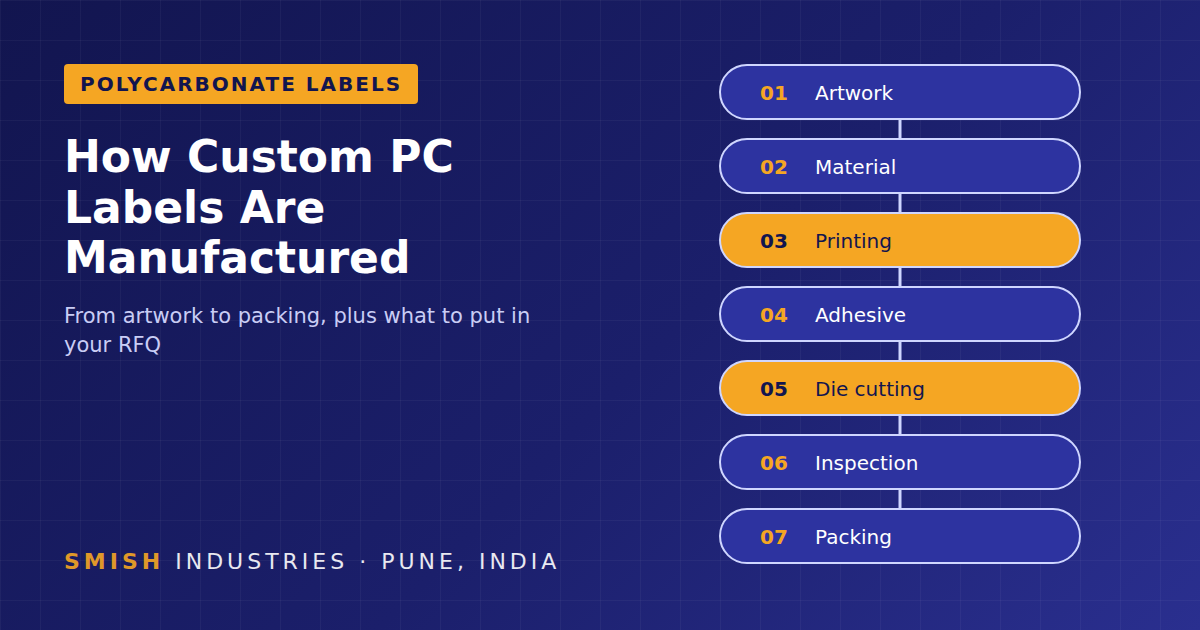
Custom polycarbonate labels are made in seven stages: artwork preparation, material selection (film grade, finish and gauge), reverse printing, adhesive lamination, die cutting of profiles and windows, inspection against the approved sample, and protective packing. OEM buyers get faster, more accurate quotes when they provide a dimensioned drawing, vector artwork, finish and adhesive requirements, substrate details, operating conditions and quantity.
Stage 1: Artwork and Drawing Review
Every job starts with the customer's drawing and artwork. At this stage we check:
- Dimensions and tolerances, including the outline, windows, switch positions and mounting holes
- Vector artwork with outlined fonts and clear layer separation (colours, white backer, windows, dead-front areas)
- Colour references for brand or panel colour matching
- Critical features such as LED windows, display areas, embossed keys and adhesive-free zones
Artwork for reverse printing is mirrored and layered in a specific order. We prepare the production artwork and share a proof for approval before printing.
Stage 2: Material Selection
Material is chosen according to the application:
- Film gauge: thinner films for flexible overlays and keypads. Heavier gauges for stiffer nameplates and panels.
- Surface finish: gloss, matte, velvet, textured or hard-coated, depending on appearance, glare, fingerprint and abrasion requirements.
- Special grades: UV-resistant films for outdoor use, and hard-coated films for chemical and scratch resistance.
If polycarbonate is not the best fit, for example where a label needs very high flex life or specific chemical resistance, we may suggest an alternative such as polyester. See our polycarbonate vs polyester guide.
Stage 3: Printing
Most industrial PC labels are reverse printed on the back of the film so the ink is protected. Depending on the design, printing may involve:
- Screen printing for opaque solid colours, backgrounds, white backers and transparent LED colours
- Digital printing for complex multi-colour graphics, gradients and variants
- Layered printing such as colour, then white, then blocking layer, to control opacity and backlighting
- Dead-front effects where icons appear only when backlit
Colour and registration are checked against the approved proof during the run.
Stage 4: Adhesive Lamination
After printing and drying, a pressure-sensitive adhesive is laminated to the back of the printed film. Adhesive choice depends on:
- The substrate: metal, painted panel, ABS, PC, powder coat or low-surface-energy plastic
- Surface texture and flatness
- Operating temperature and environmental exposure
- Design needs such as adhesive-free windows or switch areas
Stage 5: Die Cutting
The laminated sheet is cut to the final shape, including external profiles, internal windows, holes and slots. Registration between print and cut is the key quality factor for overlays, because a small offset is visible around switches and windows. The cutting method and tooling are chosen based on geometry, tolerance and volume. If embossed features are required, forming is done in register with the print before or alongside cutting.
Stage 6: Inspection
Finished labels are inspected against the approved sample and drawing:
- Colour match and print quality
- Print-to-cut registration and critical dimensions
- Window clarity, with no specks, scratches or ink smears
- Emboss position and consistency (where applicable)
- Adhesive coverage and clean liner release
- Edge quality, free of burrs or lifting
Where customers have specific inspection or test requirements, these are agreed before production.
Stage 7: Packing
PC surfaces can scratch in transit, so labels may be supplied with a protective masking film on the face. Packing format, such as sheets, individual pieces, quantity per pack and interleaving, is agreed with the customer to suit their line and storage.
What Should OEM Buyers Specify in a Quotation Request?
A complete RFQ reduces back-and-forth and gives you comparable quotes. Include:
- Dimensioned drawing with tolerances, windows, holes and critical features
- Vector artwork (AI, PDF, EPS or CDR) with colour references
- Film finish: gloss, matte, textured or hard-coated
- Film gauge, or the required stiffness if the gauge is not yet defined
- Special features: clear or tinted windows, LED windows, dead-front icons, embossing
- Substrate material and surface finish of the panel
- Adhesive requirements, including any adhesive-free zones
- Environment: indoor/outdoor, temperature range, UV, chemicals and cleaning agents
- Testing or customer specifications that must be met
- Quantity: sample quantity, first batch and estimated annual volume
- Packing and delivery requirements
- Target timeline for samples and production
Common Issues and How to Prevent Them
- Colour mismatch with other parts: provide physical colour references or approved master samples, not only screen values.
- Misalignment with switches or displays: define datum points and critical dimensions on the drawing.
- Adhesive lifting at edges: share the actual substrate and cleaning method, and test on production parts.
- Scratched windows on arrival: specify face masking film and suitable packing.
- Revisions after sampling: confirm all features, including LED windows and emboss, before the first proof.
How Long Does the Process Take?
Timelines depend on artwork readiness, material availability, tooling requirements and the number of sample iterations. We confirm sampling and production schedules once the drawing and specifications are reviewed.
Frequently Asked Questions
Do I need a drawing to get a quotation?
A dimensioned drawing gives the most accurate quote. If you only have a sample or a sketch, we can help develop the drawing, and the quotation will reflect that.
Can you match our existing panel colours?
Colour matching is done against references you supply. Physical samples are more reliable than on-screen colours.
What file formats do you accept for artwork?
Vector formats such as AI, PDF, EPS and CDR are preferred, with fonts converted to outlines.
Can you produce a small sample batch before production?
Yes. Sampling is the normal step for custom PC labels so fit, colour and adhesion can be verified on your product.
Can you make both the overlay and other labels for the same product?
Yes. SMISH manufactures polycarbonate labels alongside dome labels, vinyl labels, barcode labels and adhesive die cuts, which helps keep colours and quality consistent across a product.
Related from SMISH Industries
- Polycarbonate Label – product page
- Polycarbonate labels manufacturer in Pune
- Graphics labels
- Industrial graphics and nameplates
- Industrial labels
Start Your Polycarbonate Label Project
Have a drawing or sample ready? Send SMISH Industries your drawing, artwork, finish and adhesive requirements, operating conditions and estimated quantity. We will review the design and respond with a quotation and sampling plan.
Phone: 08048036495 | Email: smishassociate@gmail.com
Factory: Gat No. 1408, Mahalaxmi Industrial Estate, Chikhali, Pune, Maharashtra 411062
Keywords