
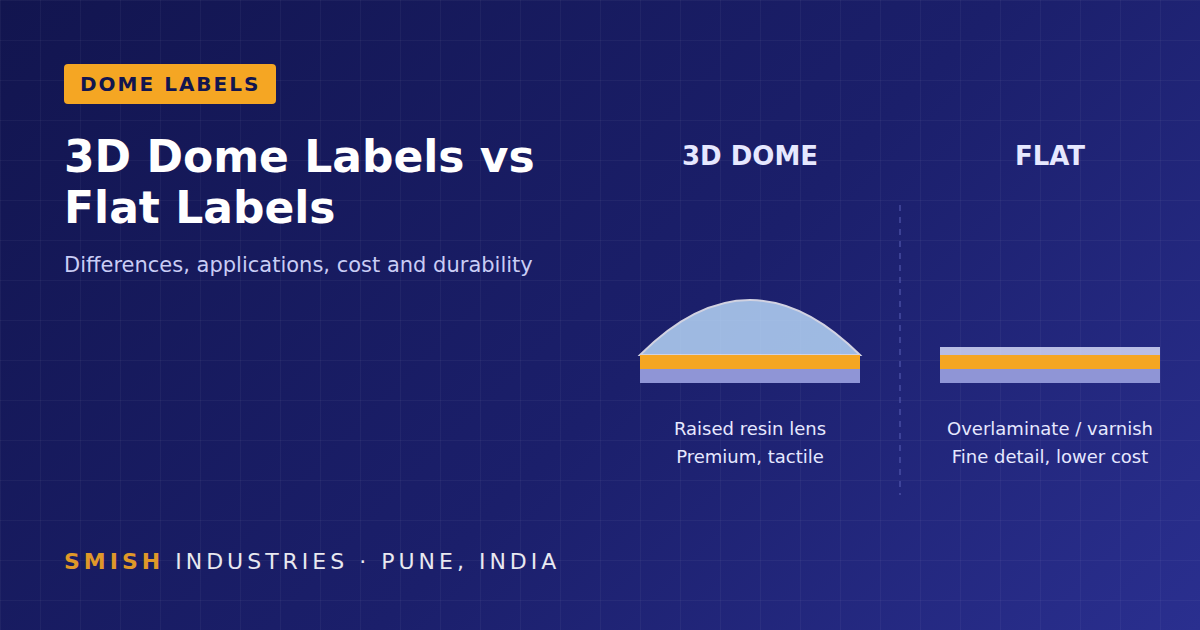
When a product team finalises branding, the question often comes up late: should the logo be a 3D domed label or a flat printed label? Both are pressure-sensitive labels and both can be made durable. They differ in appearance, protection, design limits and cost structure. This comparison of 3D dome labels vs flat labels is meant to help you choose based on the application, not on habit.
Quick Answer
A 3D dome label is a printed label topped with a clear, raised polyurethane resin lens. A flat label is printed film, often with a protective overlaminate or varnish. Dome labels give a premium, tactile look and extra graphic protection, and suit visible brand logos and badges. Flat labels are more economical and suit larger sizes, fine text, information and warning labels. They also go where a raised surface is not wanted.
What Is a 3D Dome Label?
A domed label is made by printing artwork on a base film, die-cutting it to shape, then dispensing clear two-part polyurethane resin onto each label. The resin flows to the edge, forms a lens and cures. The result is a raised, glossy label that magnifies the graphics. For a detailed look at the process, see SMISH 3D dome labels.
What Is a Flat Label?
A flat label is a printed film such as vinyl, polyester (PET), polycarbonate or paper, with adhesive on the back. For industrial use, the print is usually protected by an overlaminate, a varnish, or reverse printing on a clear film. Flat labels include nameplates, rating plates, warning labels, barcode labels, decals and graphic overlays.
3D Dome Labels vs Flat Labels: Side-by-Side Comparison
- Appearance – Dome: raised, glossy, lens-like, premium. Flat: clean and flat. Gloss, matte or textured finishes are possible.
- Feel – Dome: soft, rounded, component-like. Flat: smooth and flush with the surface.
- Graphic protection – Dome: a thick resin layer over the print. Flat: protection from overlaminate, varnish or reverse printing.
- Fine detail and small text – Dome: limited, because magnification and edge curvature can distort fine text. Flat: very good.
- Shape freedom – Dome: best with smooth outlines. Sharp internal corners and cut-outs are difficult. Flat: almost any die-cut shape, including windows and slots.
- Size range – Dome: most practical for small to medium logos and badges. Flat: from very small to large panels and decals.
- Curved surfaces – Dome: PU domes follow gentle curves. Flat: thin flexible films can follow tighter curves.
- Production process – Dome: print, cut, resin dispense, cure, inspect. Flat: print, protect, cut, inspect.
- Lead time – Dome: usually longer because of curing time. Flat: usually shorter.
- Unit cost – Dome: higher per piece for the same size. Flat: lower per piece.
- Typical use – Dome: brand logos, badges, model marks, premium identification. Flat: information, safety, barcodes, overlays, large decals.
How Do They Compare on Durability?
Neither type is automatically more durable. Durability depends on the materials chosen and the environment:
- Abrasion and handling: the resin dome adds a thick protective layer, which helps in areas touched often. A flat label with a suitable overlaminate or hard-coated film can also perform well.
- UV exposure: both need UV-stable materials for outdoor use. For dome labels, the resin itself must be UV-stable to avoid yellowing. For flat labels, the inks and overlaminate carry most of the UV protection.
- Chemicals: resistance depends on the specific resin, film, ink and adhesive against the specific chemical. Declare exposures to your supplier.
- Heat: adhesive and film ratings usually limit both types. Dome resin may also discolour under sustained high heat.
- Adhesion: both rely on the right adhesive for the substrate and a clean application surface.
The practical takeaway: choose dome or flat for appearance and design reasons, then specify materials for durability.
How Do Costs Compare?
A dome label costs more per piece than a flat label of the same size and print. The extra comes from the resin, the dispensing operation, the curing time and the extra inspection. On the other hand, a dome label often costs far less than a moulded plastic or metal badge, and it needs no fixing hardware.
Cost drivers for both include:
- Size and shape complexity
- Number of colours and special effects (metallic, chrome)
- Base film and adhesive grade
- Order quantity and batch frequency
- Testing and documentation requirements
Because these vary widely, we quote on your actual design and quantity rather than publishing generic price comparisons.
When Should You Consider a 3D Dome Label?
- The label is your brand logo or model badge in a visible position.
- You want a premium, finished appearance without the cost of a moulded or metal badge.
- The label is in a frequently touched or handled area where a thick protective layer helps.
- The design is bold and simple, with smooth outlines.
- You are upgrading a product's perceived value, for example in a new model or premium variant.
When Is a Flat Label Sufficient?
- The label carries information: ratings, specifications, instructions, serial numbers or barcodes.
- It is a safety or warning label, where legibility and compliance matter more than appearance.
- The label is large, or has fine text, windows or intricate cut-outs.
- It must sit flush, for example under a cover, behind a panel or in a tight clearance.
- Cost per piece is the main driver and a raised finish adds no value.
Can You Combine Both?
Yes. Many OEMs use a dome label for the brand logo and flat labels for everything else, such as rating plates, warning labels and control panel graphics. Some designs also apply a dome only to the logo area of a larger flat graphic. Keeping all labels with one supplier helps maintain colour consistency across the product.
Common Mistakes to Avoid
- Doming fine text: small text near the edge of a dome can look distorted. Keep text bold and central, or use a flat label.
- Ignoring the substrate: a premium dome label will still fail on polypropylene if the adhesive is wrong.
- Specifying indoor materials for outdoor products: this applies equally to domed and flat labels.
- Approving on screen only: dome appearance depends on the physical sample. Approve a real sample on the part.
Frequently Asked Questions
Are dome labels more durable than flat labels?
Not automatically. The dome adds a thick protective layer over the print, but overall durability depends on resin, film, ink, adhesive and the environment. A well-specified flat label can be very durable.
Why are dome labels more expensive?
They need extra material (resin), a dispensing step, curing time and additional inspection for dome defects such as bubbles and uneven edges.
Can a flat label look premium?
Yes. Metallised films, brushed-metal effects, selective gloss and textured finishes can make flat labels look high-end. A dome adds depth and a raised feel that flat labels cannot fully replicate.
Can barcodes or QR codes be domed?
It is technically possible, but the curved resin can affect scanning, especially near the edges. Flat labels are generally a better choice for codes.
Which is better for automotive badges?
For visible brand and model badges, dome labels are commonly considered for their premium look. For under-bonnet information, warnings and service labels, flat labels are usually more appropriate.
Related from SMISH Industries
Not Sure Which Label Your Product Needs?
Share your artwork, label position, substrate and operating environment with SMISH Industries. We can suggest whether a dome label, a flat label or a combination suits your product, and quote for both where useful.
Phone: 08048036495 | Email: smishassociate@gmail.com
Factory: Gat No. 1408, Mahalaxmi Industrial Estate, Chikhali, Pune, Maharashtra 411062
Keywords