
Buyers looking for a 3D dome labels manufacturer in India usually want two things: a label that makes their brand look premium on the product, and one that still looks right after years in a factory, a vehicle cab or an outdoor enclosure. This guide explains how 3D domed labels are made, which materials matter, where they are used, and what to specify when you ask for a quotation.
Quick Answer
A 3D dome label is a printed, die-cut label coated with a clear, flexible polyurethane (PU) resin that forms a raised, lens-like dome. The dome magnifies the graphics, gives a glossy three-dimensional look and adds a protective layer against scratches, moisture and handling. OEMs use resin dome labels for logos, badges, nameplates and model identification on machines, vehicles, appliances and electronics.
What Is a 3D Dome Label?
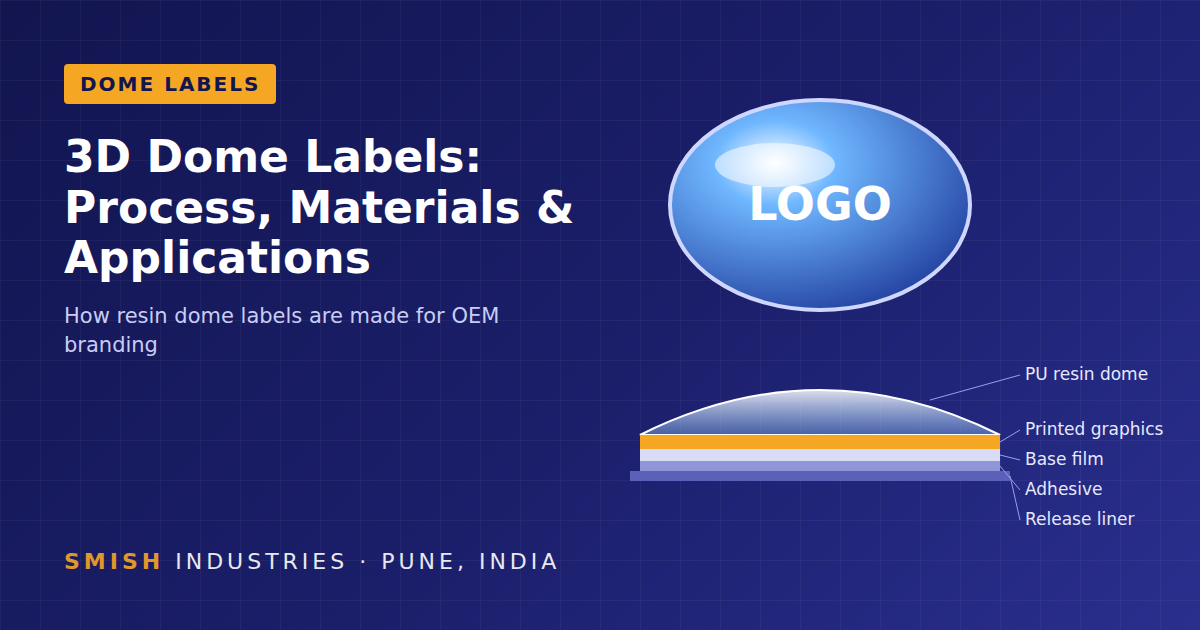
A 3D dome label (also called a domed label, resin dome label or domed logo label) has three layers:
- Printed base label – a film such as vinyl, polyester or a metallised film carrying the logo or artwork.
- Pressure-sensitive adhesive – on the back of the base film, protected by a release liner until application.
- Clear resin dome – a two-part polyurethane resin dispensed on top of the print, which flows to the edge of the label and cures into a smooth, raised, transparent lens.
The dome is what separates it from a flat printed sticker. Light passing through the curved resin makes colours look deeper and edges look sharper, which is why dome labels are commonly used where the brand mark needs to look like a fitted component rather than a sticker.
How Are 3D Dome Labels Manufactured?
At SMISH Industries, dome label production follows a controlled sequence. Each stage affects the final appearance, so buyers benefit from understanding it.
1. Artwork preparation
The customer's logo is checked for print resolution, colour references and the label outline. The outline matters more for dome labels than for flat labels: resin is held at the edge by surface tension, so smooth contours and rounded corners dome evenly, while very sharp internal corners, thin lines and narrow slots can be difficult to fill consistently. We review the shape before production and suggest adjustments if the outline may not dome well.
2. Printing the base label
The artwork is printed on the selected base film. Printing method and ink system are chosen according to the colours, the need for metallic or special effects, and the environment the label will face. Colour matching to brand references is agreed at the sampling stage.
3. Adhesive selection
Adhesive is selected before printing because it is part of the base material. The choice depends on the surface the label will be applied to:
- Smooth metal, painted panels and most rigid plastics generally work with a permanent acrylic adhesive.
- Low-surface-energy plastics (for example polypropylene, polyethylene and some powder coats) usually need a high-tack adhesive formulated for such surfaces.
- Textured or slightly uneven surfaces may need a thicker adhesive or a foam-backed construction to achieve full contact.
4. Die cutting
The printed sheet is kiss-cut to the final label shape, leaving the labels on the liner. Accurate cutting is essential because the cut edge defines where the resin will stop.
5. PU resin doming
A measured quantity of clear two-part polyurethane resin is dispensed onto each label. The resin spreads to the cut edge and forms the dome. Dispensing volume, label size, shape and resin viscosity together determine the dome profile, so these are controlled for each job rather than applied as a fixed setting.
6. Curing
The domed sheets are left to cure on level, dust-controlled surfaces until the resin is fully hardened. Premature handling or an uneven surface can cause dents, flow marks or uneven dome height, so curing time is not shortened to meet deadlines.
7. Quality inspection
Finished labels are inspected for common dome defects, including:
- Air bubbles or voids inside the resin
- Dust or foreign particles
- Resin overflow beyond the edge or incomplete edge coverage
- Uneven dome height across a batch
- Print registration, colour and outline accuracy against the approved sample
Approved labels are then packed flat on their liner so the domes are not crushed in transit.
What Materials Are Used in Resin Dome Labels?
Base films: white or clear vinyl for general branding, polyester (PET) where dimensional stability and heat resistance are more important, and metallised or brushed-effect films for a chrome or metal look.
Dome resin: polyurethane is widely preferred for domed labels because it stays slightly flexible after curing, which helps it follow gentle curves and resist cracking. Some older or low-cost domes use epoxy, which is harder and can be more prone to yellowing outdoors. For outdoor or UV-exposed products, buyers should ask specifically about the UV stability of the resin.
Adhesives: permanent acrylic, high-tack adhesives for low-surface-energy plastics, and foam or thick-adhesive options for textured surfaces. The final choice depends on your substrate and should ideally be confirmed by testing on your actual part.
Where Are Industrial Dome Labels Used?
- Automotive and two-wheelers: model badges, variant identification, accessory branding and dealer-fitted logos.
- Agriculture and earth-moving equipment: brand logos and model marks on cabins, bonnets and control panels.
- Industrial equipment and machine tools: manufacturer logos, nameplates and panel branding.
- Power and generator sets: brand marks on canopies and control enclosures.
- Electronics and appliances: product logos on front panels, remotes and housings.
- Furniture and office products: branding on chairs, cabinets and fittings.
- Medical equipment: brand identification on device housings (material and cleaning compatibility must be confirmed by the device manufacturer).
What Are the Benefits of 3D Domed Labels?
- Premium appearance: the raised, glossy lens gives a finish that reads as a fitted badge.
- Graphic protection: the resin layer shields the print from abrasion, handling, splashes and cleaning.
- Tactile quality: the soft, rounded dome feels like a component, which supports perceived product value.
- Flexibility: PU domes can be applied to gently curved surfaces that a rigid badge might not suit.
- Lower tooling than moulded badges: for many logos, a dome label can deliver a 3D look without the tooling investment of a moulded or metal badge. Where a stronger relief is required, SMISH also produces ELEVEX 3D badges and logos.
How Durable Are Dome Labels?
Durability depends on the full construction, not the dome alone. The main factors are:
- UV exposure: outdoor equipment needs UV-stable resin, inks and base film.
- Temperature: labels near engines, exhausts or hot enclosures need materials and adhesives rated for that heat.
- Chemicals: exposure to fuel, oils, coolants or aggressive cleaners should be declared so compatibility can be checked.
- Surface preparation: most adhesion failures come from dust, oil, mould release or moisture on the part at the time of application.
- Mechanical wear: areas that are repeatedly touched, washed or scraped may need a different size, placement or construction.
We do not quote a single lifespan for all dome labels, because real service life depends on these conditions. For critical applications, we recommend approving samples on your actual part and running your internal environmental tests before series supply.
How Can Dome Labels Be Customised?
- Custom shapes and sizes to match the logo outline
- Full-colour, spot-colour and metallic-effect printing
- Chrome, brushed-metal or transparent base films
- Adhesive matched to the substrate
- Supply on sheets or in the format your assembly line needs
Why Do OEMs Use Dome Labels?
For OEMs, a dome label is often the most practical way to give a product a branded, finished look at production volumes. It applies quickly on the line, requires no fasteners, protects the brand graphics and can be revised easily when a model or variant changes. For sourcing teams, the key is working with a manufacturer who asks about the environment, substrate and application method up front, rather than treating every dome label as the same product.
Frequently Asked Questions
What is the difference between a dome label and a 3D sticker?
'3D sticker' is a loose term. A true dome label has a clear resin layer dispensed and cured on top of the print, which creates a real raised lens. Some '3D stickers' are flat prints with a 3D-effect design and no resin.
Are dome labels suitable for outdoor equipment?
They can be, provided the resin, inks, base film and adhesive are selected for UV and weather exposure. Tell your supplier if the label will be used outdoors so the right materials are specified.
Can dome labels be applied on curved surfaces?
PU dome labels have some flexibility and can usually follow gentle curves. Tight or compound curves should be evaluated with samples on the actual part.
What shapes cannot be domed well?
Very sharp internal corners, thin lines, narrow gaps and cut-outs inside the label are difficult for the resin to fill evenly. A manufacturer can usually suggest a small outline change that keeps the logo intact.
What is the minimum order quantity for custom dome labels?
MOQ depends on size, colours and construction. Share your artwork and estimated annual quantity and we will advise the practical minimum for your design.
What details are needed for a dome label quotation?
Artwork (vector format preferred), finished size, quantity, the surface it will be applied to, indoor or outdoor use, and any temperature, chemical or testing requirements.
Related from SMISH Industries
- 3D Dome Label – product page
- Dome label supply with pan-India delivery
- 3D logo labels
- Automotive graphics
- Industrial labels
Request a Dome Label Quotation
Looking for custom 3D dome labels for your OEM or industrial product? Send SMISH Industries your artwork, label size, target surface, application environment and estimated quantity. Our team will review the design for doming, recommend suitable materials and share a quotation.
Phone: 08048036495 | Email: smishassociate@gmail.com
Factory: Gat No. 1408, Mahalaxmi Industrial Estate, Chikhali, Pune, Maharashtra 411062
Keywords